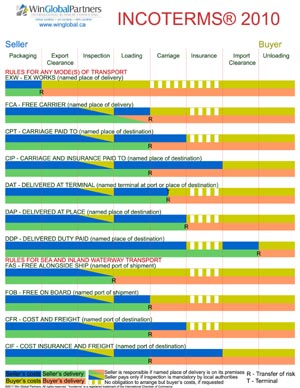
Win Global Partners are glad to share Incoterms® 2010 Wall Chart designed by our specialists based on the official ICC guidebook.
|
FREE Basic Version of Incoterms® 2010 Wall Chart is available in: English Français |
Advanced Version of Incoterms® 2010 Wall Chart is available in: English Français Español Deutsch Русский |
||
|
It includes:
|
It includes:
|
||
|
What Our Clients Are Saying
|
|
||
|
Aerospace & Defense
Mobile Technologies
Logistics |
Automotive
Energy
Chemicals
Metallurgy |
Oil, Gas & Mining
Fast Moving
Finance |
Consumer Electronics
Hardware
Consulting |
First of all, there are two classes of terms - those which are applicable to marine transport only and those which are applicable to any mode of transportation. For example, FOB (Free On Board), one of the most popular term is in the first category.
Secondly, there is a sufficient change in D group of terms. Starting January 1st, 2011, DES (Delivered Ex Ship), DEQ (Delivered Ex Quay Duty Unpaid), DDU (Delivered Duty Unpaid) and DAF (Delivered At Frontier) will be replaced by DAT (Delivered at Terminal) and DAP (Delivered at Place).
In Incoterms® 2010 the International Chamber of Commerce reflected the growing global economic integration as new terms can be applicable to the internal trade, not only to the international trade as it was before.
Rising security costs in the international shipments are now defined in Incoterms® 2010 as a separate category of costs like insurance costs. Parties are welcome to negotiate who will cover those costs.
The last, but not least important change is that the place of transferring risk now has to be as precise as possible. For example, former DDP Halifax (Delivered Duty Paid) now should be indicated as DDP 3299 John St., Halifax, NS, Canada. The purpose of this precision is to make sure that a correct term has been chosen and to avoid miscommunication. After all, this is a strong argument for an international trade arbiter.
Create your free online surveys with SurveyMonkey, the world's leading questionnaire tool.
“Trade patterns in Asia are shifting and traditional business models, built on buying cheaply in Asia and selling at higher prices in the United States, won’t easily fit the new reality. Multinationals need to evaluate the suitability of their business models for the booming opportunities in trade between emerging markets.”
Niraj Dawar, Richard Ivey School of Business
|
|
Email us: info@winglobal.ca |
|
Call us: +1.647.800.7233 |
|
Meet with us. We`ll come to you |
|
Get a free quote |
© 2010-2012 Win Global Partners - All Rights Reserved.